A simple cementation method to prevent material extrusion into the periimplant tissues
Cement-retained implant restorations offer a number of prosthetic advantages over screw-retained alternatives, but they carry a well-recognized risk

Dr. Suzanne Caudry
Periodontist
Table of contents
Share
Background & clinical context
Cement-retained implant restorations offer a number of prosthetic advantages over screw-retained alternatives, but they carry a well-recognized risk: excess cement extruded during cementation can migrate apically into the peri-implant tissues and act as a persistent foreign body.
The biological consequences range from soft tissue inflammation and suppuration to progressive bone loss. These complications can ultimately threaten both the implant and the overlying restoration.
Unlike natural teeth, implants lack a true connective tissue attachment at the abutment-crown interface. This means there is no biological barrier to prevent cement from tracking apically along the abutment collar during seating.
The problem is compounded by sulcus depth, abutment contour, and implant surface irregularities; all of which make detection and removal of excess cement difficult, whether approached non-surgically or surgically. Prevention is therefore the most reliable management strategy.
Why this complication is easy to miss |
|---|
Residual cement is frequently invisible on periapical radiographs, particularly when non-radiopaque cements are used or when excess is located on the buccal or lingual surfaces. Peri-implant inflammation attributable to retained cement can be clinically indistinguishable from peri-implantitis of bacterial origin. This makes prevention far preferable to diagnosis and management after the fact. |
Existing prevention strategies
Strategy | Rationale |
|---|---|
Supragingival or equigingival margin placement | Allows direct visual access to cement margins; most reliably prevents apical cement migration |
Lingual escape hole in the crown | Provides a coronal escape route for excess cement, redirecting flow away from the sulcus |
Establishing peri-implant tissue health pre-cementation | Firm, healthy tissue provides a natural resistance to apical cement tracking |
Minimizing cement volume at placement | Less cement in the crown at seating reduces total extrusion volume |
Custom abutment replica (this technique) | Allows controlled extraoral extrusion of most excess cement before intraoral seating |
The custom abutment replica technique
Here we describe a simple, practical method to dramatically reduce the volume of cement introduced into the peri-implant sulcus at the time of crown delivery.
The core principle is straightforward: by seating the loaded crown on an extraoral putty replica of the abutment first, most excess cement is expressed outside the mouth in a controlled setting before the restoration is placed intraorally.
01 Evaluate the implant platform level relative to the gingival crest — either clinically or on the definitive cast. |
02 Select the abutment collar margin position: just apical to the gingival crest in the esthetic zone; at or slightly occlusal to the gingival crest elsewhere. |
03 Fabricate a custom putty replica of the implant abutment. This can be done chairside or in the laboratory using a polyvinyl siloxane putty material. |
04 At cementation, load the crown with cement and seat it on the putty replica first. This extraoral step expresses the majority of excess cement. Only a thin residual layer remains inside the crown. |
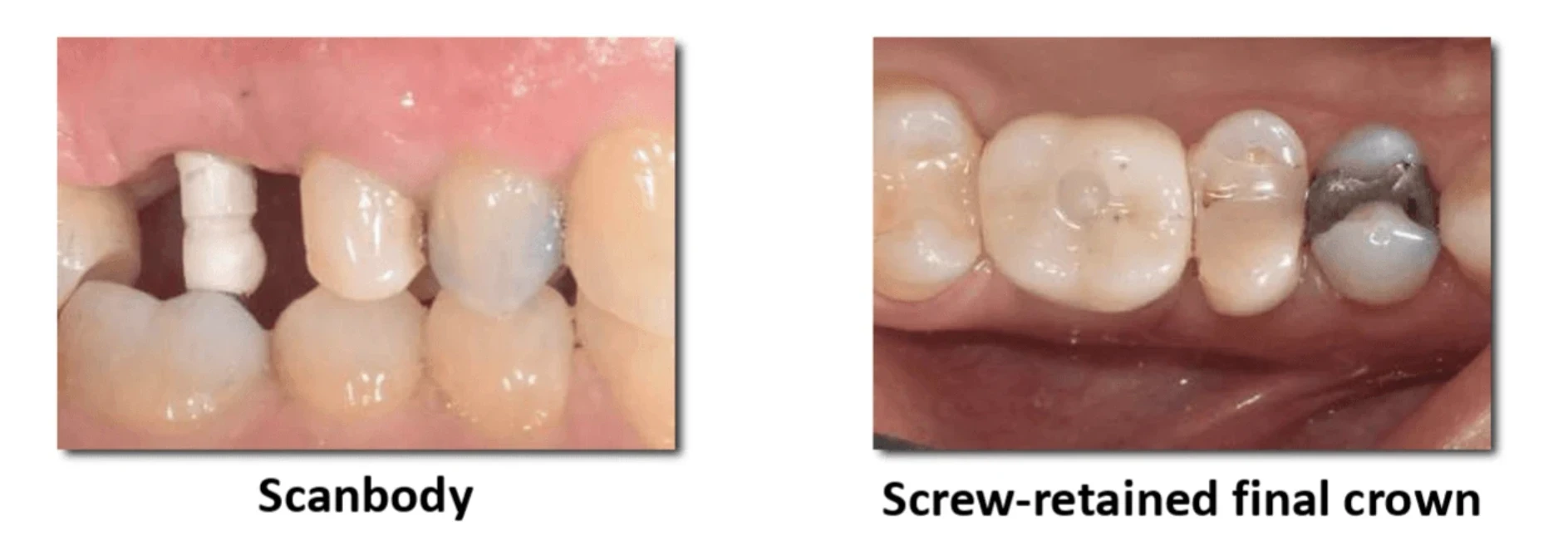
05 Transfer the crown to the intraoral abutment. Evaluate margins for complete seating and remove any remaining cement. |
The clinical advantage |
|---|
By extruding most cement extraorally against the putty replica, the clinician retains full control over excess cement removal before the restoration ever enters the mouth. When the crown is subsequently seated intraorally, only a thin cement film remains, substantially reducing the volume available to migrate apically into the peri-implant sulcus. The technique requires minimal additional materials and no specialized equipment beyond the putty impression material used for the replica. |
Clinical relevance
Cement-related peri-implant complications are preventable, but only if prevention is actively built into the cementation protocol.
This technique addresses one of the most controllable variables in that process: the amount of cement introduced intraorally. Combined with appropriate margin placement, healthy peri-implant tissues at the time of delivery, and thorough post-cementation inspection, the custom abutment replica method offers a practical, low-cost addition to a comprehensive cement management strategy.
The technique is particularly relevant in cases where subgingival margins are unavoidable, such as in high esthetic-demand zones where margin visibility must be sacrificed for appearance, where the risk of undetected apical cement migration is highest.
Article Reference
Suzanne Caudry, PhD, DDS, MSca Send email to scaudry@drcaudry.ca ∙ David Chvartszaid, DDS, MScb ∙ Nicholas Kemp, BDS, DDSc A simple method to minimize cement overflow at the time of cementation of implant-supported restorations using a custom-made abutment replica. The Journal of Prosthetic Dentistry.