Solutions for Limited Interdental Spaces
These patients present a challenge both surgically and restoratively.

Dr. Suzanne Caudry
Periodontist
Table of contents
Share
Do you have patients with limited space due to:
Congenitally missing teeth
Drifting of teeth
Orthodontic treatment
Normal anatomy (e.g. maxillary laterals and mandibular incisors)
These patients present a challenge both surgically and restoratively.
Case Study 1
Before
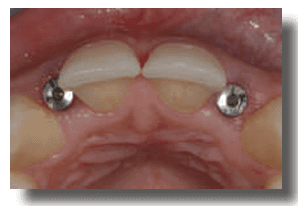
This patient wore an orthodontic retainer for many years and was interested in a more esthetic, long-term solution.
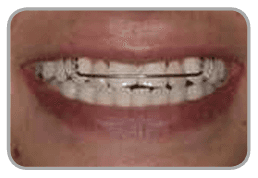
Surgical procedure
Two Astra Tech OsseoSpeed TX 3.0 implants were placed in upper lateral positions with limited space. With clinically-documented bone loss of only 0.3mm over five years, the current bone levels will be maintained ensuring long-term esthetics.
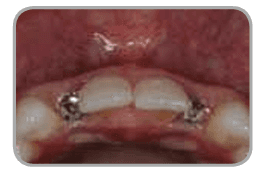
Restorative procedure
Astra Tech OsseoSpeed TX 3.0 implants have a 2.6mm restorative platform providing an optimal emergence profile in an area with limited space. ATLANTIS Abutments, GoldHue are computer-designed to ensure that the final abutment is the most appropriate size for the interdental space. Also note the abutment design makes maximum use of the available space.
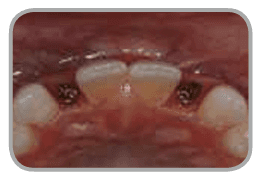
After
In addition to providing the strength of titanium, the gold shade of the ATLANTIS Abutment, GoldHue provides an underlying warmth to the final zirconia crown.
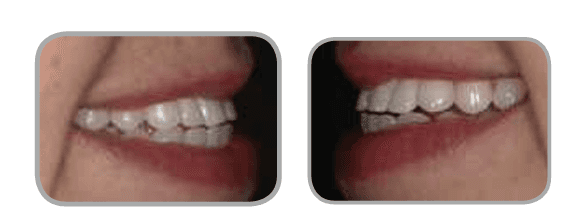
Surgery and photos by Dr. Caudry.
Case Study 2
Do you have patients who are frustrated with repeated debonding and poor esthetics of a Maryland bridge? Notice the lack of buccal bone, which certainly contributes to the poor esthetics.
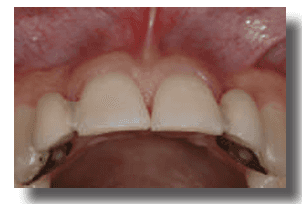
With less than 5mm (site 12) of available space, an OsseoSpeed TX 3.0 S implant was placed. The implant has a 2.6 platform making it ideal for this situation and with clinically documented bone loss of only 0.3mm over 3 years we can be confident of long term success.
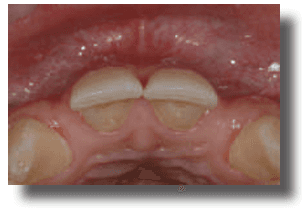
Periodontal plastic surgery (i.e. Connective Tissue Grafting or 'CTG') was done at both sites at the same time as implant placement to emulate natural root eminence and the natural anatomy of the soft tissue zone. It is a common misconception that CTGs are painful procedures. This patient - and he is typical - reported on recall that not even Advil was necessary post-operatively. In this case, a palatal flap was raised adjacent to the sites. The CTG is harvested from inside the palatal flap (similar to a free gingival graft) and sutured on the buccal aspect of the implants.
Since primary stability of the implants was achieved at surgery, healing abutments were placed. Note that this photograph was taken two weeks post-operatively.
At ten weeks an impression was taken and ATLANTIS Abutments and the final crowns were inserted at week 12. One surgery, impressions and delivery - no temporization. Note the recreation of the root eminence by using connective tissue grafting.

Surgery and photographs by Dr. Caudry.