
Dr. Theo Katsaros
Lead periodontist
Last Updated
Share
Background
What is a dental implant supported bridge?
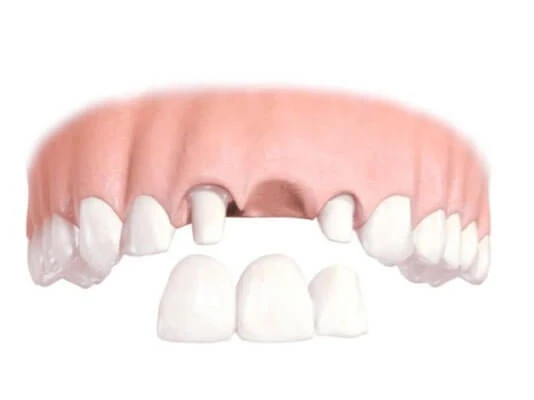
A dental bridge bridges the gap left by a missing tooth or several missing teeth, restoring both the appearance and function of your smile.
An implant supported bridge works by anchoring false teeth, called a pontic, to the dental implants on either side of the gap. Those anchors, known as abutments, are fitted with crowns that hold the pontic firmly in place.
The result is a seamless, stable restoration that lets you chew, speak, and smile with confidence.
Beyond the cosmetic benefit, a bridge plays an important role in protecting your long-term oral health. When a tooth is missing, the surrounding teeth can begin to drift out of position over time, which can affect your bite and create problems that are harder to treat later. A bridge fills that space before those shifts can occur.
Types of dental bridges
The right type of bridge depends on your individual situation, including the location of the missing tooth, the health of the surrounding teeth, and your bone structure. During your consultation, we will assess your teeth and recommend the right option for you.
Traditional bridges are the most common type. A false tooth is held in place by crowns placed on the healthy teeth on either side of the gap. These work well when you have strong, healthy abutment teeth on both sides.
These types of bridges can be done at any dental clinic.Cantilever bridges are used when there is only one healthy tooth adjacent to the gap. The bridge is anchored on one side rather than two, making this a suitable option in specific situations where a traditional bridge is not possible.
Maryland bridges use a porcelain or metal framework that bonds to the back surfaces of the neighbouring teeth, requiring less reshaping of the natural tooth structure. These are often used for front teeth where the bite forces are lower.
Implant-supported bridges replace the anchor teeth with dental implants rather than natural teeth, making them the most stable and long-lasting option. These are particularly well suited when multiple teeth are missing.
These are the types of bridges that a periodontal clinic is best suited for.
Our process
Dental implant supported bridges at Bloor-Yorkville Periodontics
Placing a dental bridge is a precise process that takes place over two appointments. Here is what you can expect from start to finish.
Step 1: Examination and treatment planning
We begin with a thorough review of your dental and medical history and a careful examination of your mouth, including the teeth surrounding the gap. Digital X-rays give us a clear picture of your bone structure and the health of your abutment teeth.
Once we have completed our assessment, we will walk you through our findings, confirm if an implant supported bridge is the right solution for you, and recommend the most appropriate type based on your specific situation.
Step 2: Preparing the abutment implants
Before your bridge can be placed, the dental implants on either side of the gap need to be placed to accommodate the crowns that will anchor your bridge. We begin by administering a local anesthetic so you are comfortable throughout this step.
Once the area is numb, we will place the implants and take precise impressions of your mouth. These impressions are sent to your dentist, where they can coordinate the creation and placement of the bridging teeth.
Step 3: Temporary bridge placement
While your permanent bridge is being made, usually over the course of one to two weeks, we will place a temporary bridge to protect your implants and maintain the space. This allows you to eat, speak, and go about your daily life comfortably while you wait.
Step 4: Working with your family dentist
Your final bridge will be coordinated with your family dentist so that they can check the fit, colour, and bite of your new permanent bridge carefully before cementing it in place.
Once everything looks right and feels comfortable, they will use dental cement to secure the bridge permanently onto the dental implants we placed.

I came in with several complicated dental issues (bone graft, implant and bridge cut) that I was very anxious about. From the very first visit, I knew I was in the best hands. They took the time to thoroughly explain every step of the treatment plan, made sure I was comfortable throughout the process, and used the latest techniques to achieve results that honestly exceeded my expectations. Their skill, precision, and genuine care turned what I thought would be a stressful experience into something truly positive. Not only does my smile look amazing now, but I can also finally eat comfortably and feel confident again. The entire staff is warm, professional, and incredibly attentive—every visit feels more like catching up with friends than a trip to the dentist. If you’re looking for a dentist who combines expertise, artistry, and compassion, look no further. I would give more than 5 stars if I could!
Mary Michelle Derouard
Google Review
Your Periodontal Specialists
Why choose Bloor-Yorkville Periodontics in Toronto for a dental implant supported bridge?
At Bloor-Yorkville Periodontics, we understand that getting multiple implants for a dental bridge can feel daunting. We are committed to making that process as informed, comfortable, and clinically effective as possible.
Specialist-level care - As a periodontal practice, we bring a deep understanding of the gum and bone structures that support your teeth and your bridge, giving you a strong foundation for long-term results.
Personalized treatment - We do not take a one-size-fits-all approach. Your treatment is designed around your specific anatomy, oral health, and goals.
Continuity of care - Whether you need a bridge as a standalone treatment or as part of a broader plan that includes other periodontal care, our team is here to achieve your optimal health.
Conveniently located in Toronto - Our practice is located in Yorkville, Toronto and is easily accessible.
Periodontal disease does not resolve on its own, and delays in treatment allow it to advance to stages that are significantly more difficult and costly to manage. If uncertainty or anxiety has prevented you from seeking care, our team in Toronto is here to help you take that step with confidence.
FAQ
Frequently asked questions about dental bridges
When should I consider a dental bridge?
A bridge may be right for you if you are missing one or more teeth, if a tooth is too damaged to save and needs to be extracted, or if the gap in your smile is causing difficulty chewing or speaking.
Missing teeth can also cause neighbouring teeth to shift over time, so the sooner you address the space, the better. If you are unsure whether a bridge is the right solution, we will assess your mouth and discuss all available options with you at your consultation.
Is getting a dental bridge painful?
We use a local anesthetic to fully numb the treatment area before we place implants, so you should not feel pain during the procedure. Some mild sensitivity in the days following your appointment is normal, and we will give you guidance on how to manage any discomfort during that period.
How long does a dental bridge last?
Implant-supported bridges tend to have the longest lifespan because they are anchored directly into the jawbone rather than relying on natural teeth. If your bridge ever feels loose or you notice sensitivity around it, contact us promptly so we can assess it and address any issues early.
Will I be able to eat normally with a dental bridge?
One of the primary goals of a dental bridge is to restore your ability to chew comfortably.
After a short adjustment period of a few days, most patients find they can eat a full range of foods without difficulty. We will advise you on any foods to avoid in the early days following placement and give you tips for keeping your bridge clean and functioning well over the long term.

My experience was exceptional. I was given a appointment with minimal wait time. They extracted my problematic failed dental implant with expert precision, which many other practitioners wouldn’t even consider taking on. I felt comfortable and confident that I was going to be given the best treatment possible and I was right. I highly recommend. Thank you so much, you truly are the best.
Steven Boyd
Google Review